Language

Car washing is not simply about higher water pressure being better, nor is wider spray always cleaner. Whether a high-pressure washing gun actually works well in a car wash scenario depends on three hard indicators: whether the working pressure is sufficient to remove stubborn dirt, whether the nozzle mode can be switched quickly to suit different surfaces, and whether the gun leaks or causes hand fatigue after prolonged use.
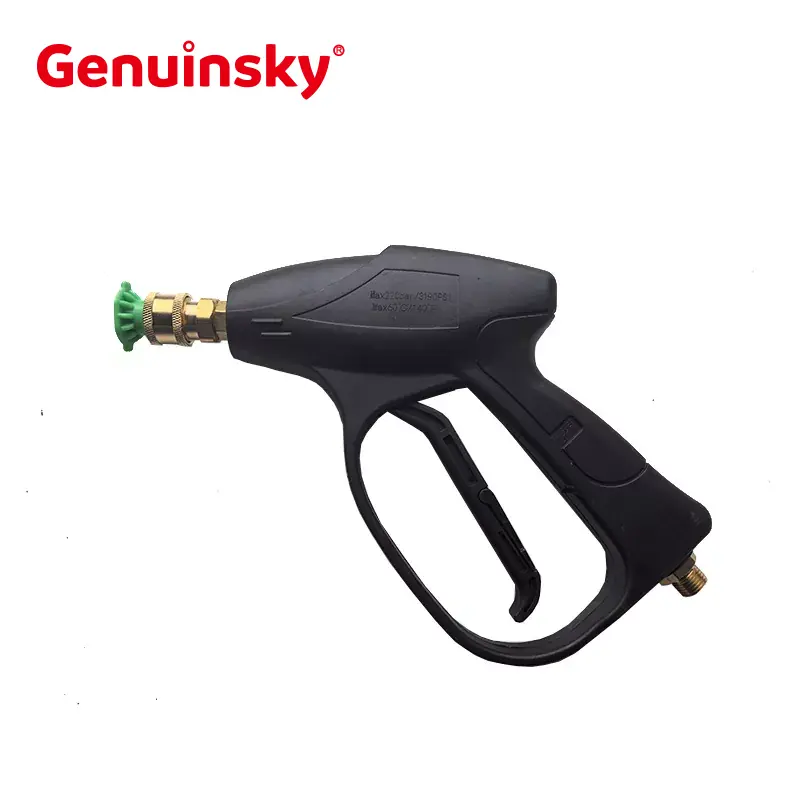
The Genuinsky brand recently launched its Model 1101 150bar 2-in-1 Nozzle High-Pressure Washing Gun, which represents a notable option in this segment. The working pressure is set at 150 bar. The front end features a rotating dual-mode nozzle. The main body uses high-strength engineering plastic with brass connectors. The rear end fits mainstream high-pressure hoses on the market. Ningbo Genuinsky Imp. & Exp. Co., Ltd., based in Jiangbei District, Ningbo, has over a decade of export experience in hardware, power tools, electromechanical equipment, cleaning machines, and welding machines. This article starts from real-world car washing scenarios and explains how to select a high-pressure washing gun, whether 150 bar is sufficient, where the 2-in-1 nozzle actually saves time, and the most common on-site problems.
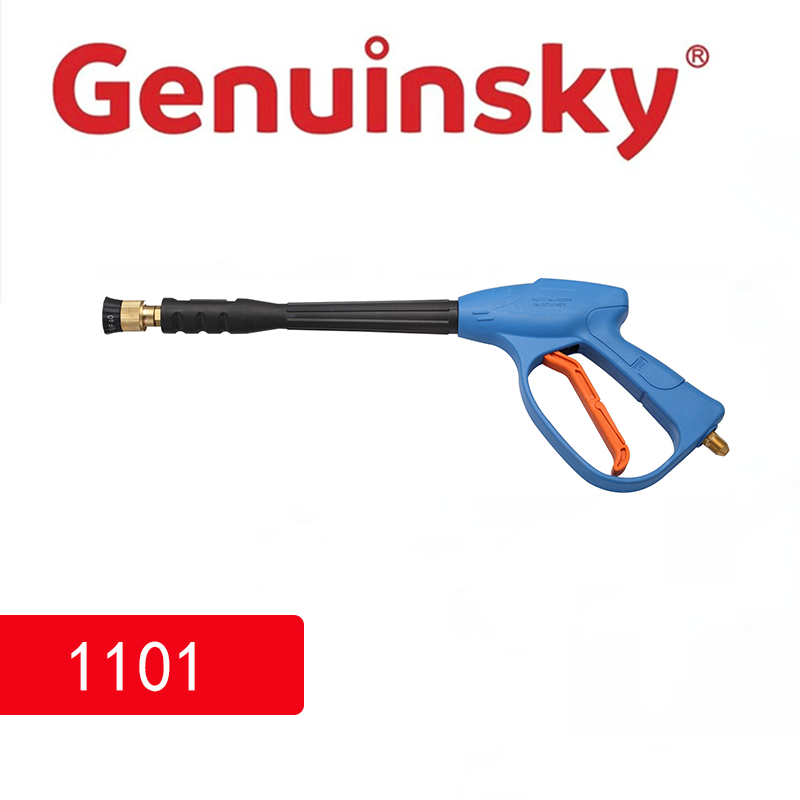
The core task of a high-pressure washing gun is straightforward: take pressurized water from the pressure washer, control it through a trigger, and deliver it to the vehicle surface in the appropriate form and pressure to remove mud, bug residue, brake dust, and other contaminants. However, in a car wash running dozens of vehicles per day, the gun's response speed, nozzle switching convenience, seal durability, and grip comfort directly determine washing efficiency and final results.
A gun with insufficient pressure requires holding the nozzle over brake dust on wheels or bug splatter on the front bumper for ten or more seconds repeatedly—wasting both water and time. Conversely, a gun with excessively high pressure and no adjustment risks damaging the clear coat when used too close to the paint. At 150 bar, this falls into the medium-to-high pressure range for car washing—sufficient to remove most stubborn dirt while remaining controllable when paired with the correct nozzle angle and working distance.
What affects efficiency even more is nozzle switching. The conventional approach requires changing to a different nozzle tip, which involves pulling off one tip and pushing on another, sometimes needing a tool. Operators find this cumbersome and often skip it, either using a straight stream that risks paint damage or using a wide spray that fails to clean mud from gaps. The 2-in-1 nozzle switches modes by simply rotating the front end. Switching time drops from ten or more seconds to one or two seconds. This difference becomes very apparent in the multiple switching operations required for a single vehicle.
In home car washing, users care most about safety—not damaging their own paint. The fan spray mode of the scattering pattern covers a large area with relatively gentle impact, suitable for pre-washing and rinsing after foam application. The straight-stream mode is specifically for cleaning inside wheel arches, grille gaps, and mirror hinges where mud accumulates.
Commercial car washes and self-serve car washes place greater emphasis on durability and maintenance cost. A gun that gets its hose connected and disconnected dozens of times per day by different users—whether the connector leaks, whether the trigger spring weakens, and whether the grip slips under heavy water flow—these are daily operational concerns.
The performance of a high-pressure washing gun is determined by several hard parameters, not by appearance or subjective feel.
The main specifications of the Genuinsky Model 1101 are summarized below:
| Parameter | Specification | Note |
|---|---|---|
| Working pressure | 150 bar | Suitable for car washing and light surface cleaning |
| Nozzle type | 2-in-1 rotating switch | Straight-stream / fan spray modes |
| Straight-stream pattern | Concentrated jet | Focused impact for gaps and stubborn deposits |
| Fan spray pattern | Widening spray | Wide coverage, gentle impact, for body and floor |
| Body material | High-strength engineering plastic | Corrosion-resistant, impact-resistant |
| Connector material | Brass | Corrosion-resistant, good sealing |
| Inlet fitting | Fits mainstream high-pressure hoses | Tool-free installation and removal |
| Handle design | Anti-slip + ergonomic curve | Blue/orange color options |
| Trigger lock | Yes | Can be locked, no continuous squeezing required |
The table shows that the design approach of the Model 1101 is to keep a fixed 150 bar working pressure and adapt to different surfaces by changing the nozzle spray pattern, rather than adding a complex pressure regulation mechanism. This approach results in a simpler structure with fewer failure points, which is practical for car washing where frequent mode switching is needed.
The internal channels of a high-pressure washing gun are subject to repeated pressure pulses at 150 bar. Material selection directly affects service life. The main body uses high-strength engineering plastic. Compared to an all-metal gun, plastic is lighter, does not feel cold in winter, and does not rust. However, the potential weakness of plastic is at the connection points and internal flow passages. Genuinsky uses brass components in these areas. Brass offers good machining precision and fits tightly with seals, making water seepage less likely even after long-term use.
It should be noted that engineering plastic has an inherent disadvantage in impact resistance when dropped. If the gun is frequently dropped onto hard surfaces from height, the plastic shell may crack. Currently, most medium-to-high-pressure washing guns follow a hybrid approach of a plastic body with metal connectors, and the Model 1101 follows this same approach.
A car wash technician may pull the trigger several hundred times in a morning. Trigger pull force, grip contour, and anti-slip texture are details that are not noticeable during a short trial but become very obvious after several hours of continuous use. The anti-slip design and ergonomic grip curve on the Model 1101 are mature approaches. What is particularly worth mentioning is the trigger lock function—when washing a large area continuously, the trigger can be locked without needing to keep squeezing. This feature significantly reduces hand fatigue in commercial car wash settings.
Home car washing: 100-120 bar is generally sufficient. Higher pressure introduces unnecessary risk. At 150 bar, this is on the higher side for home use and suits users who want stronger cleaning performance, but attention to spray distance is required.
Commercial car wash / self-serve car wash: 120-150 bar is an ideal range. The 150 bar of the Model 1101 sits at the upper end of this range. When used with fan spray mode, it remains safe for paint. The straight-stream mode handles wheels and pre-rinse tasks.
Light surface / floor cleaning: The fan spray mode can handle cleaning patios, garage floors, and walls. However, for large industrial floors or heavy grease, 150 bar is insufficient, and equipment above 200 bar is needed.
One commonly overlooked issue: whether the water inlet fitting of the gun matches the existing high-pressure hose. If not, adapters are needed, and every added adapter introduces two potential leak points. The Model 1101 claims to fit mainstream high-pressure hoses on the market with tool-free installation and removal at the rear end. This is useful for users who frequently switch the gun between different pressure washers.
In actual use, three issues occur most frequently:
The unit price of a high-pressure washing gun is a small fraction of the total investment in car wash equipment. However, choosing the wrong gun creates hidden costs far exceeding the gun's price: lower washing efficiency leading to longer wait times, uncomfortable handling leading to operator complaints, and leaks creating wet floors and safety hazards.
A common observation in the industry: many car washes use the high-pressure gun supplied free with the pressure washer when purchased. These are often basic generic products that work but are not pleasant to use. After six months to a year, when seals begin to leak and trigger feel worsens, the owner goes to find a better replacement gun. Products positioned like the Model 1101 find their main market opportunity in this replacement demand—not the cheapest, but typically one grade above the generic bundled gun in seal quality and grip feel.
Will 150 bar damage car paint?
It depends on nozzle mode and operating distance. Using fan spray mode at a distance of 30 cm or more, 150 bar is safe for factory clear coat. Using straight-stream mode at close range on a single spot does carry risk.
What is the advantage of a 2-in-1 nozzle over changing tips?
The advantage is not having to stop. Rotating the front end a half-turn switches modes with one hand, saving time. For the multiple switching operations needed on a single car, this convenience is significant.
Is a plastic-bodied gun durable?
Under normal use, yes. The main risks are dropping and long-term UV exposure. If the gun is frequently dropped onto hard surfaces, check the shell for cracks. If kept outdoors, avoid direct sunlight.
Does leaking from the nozzle tip mean the gun is broken?
Not necessarily. Minor weeping at the nozzle switch point is normal. Only significant spraying or continuous dripping after the trigger is closed indicates internal seals need replacement.
Can guns and hoses from different brands be mixed?
It depends on the fitting specification. The Model 1101 claims to fit mainstream high-pressure hoses, but "mainstream" does not mean "all." Before purchasing, it is worth confirming the thread specification of the existing hose.