Language

If you're shopping for a pressure washer, or if you've ever been frustrated by one that either blasts paint off your car or barely removes dust from your driveway, it's worth taking a few minutes to understand its two core components: the induction motor and the pressure regulator. They're the heart and brain of the machine – and they determine how much work it can handle, and for how long.
Many entry-level pressure washers use universal (series-wound) motors. They're compact and fast, but they rely on carbon brushes that wear out – typically every one to two years of regular use. They're also notoriously loud.
If a product spec says "Induction Motor," that's a strong signal of durability. Induction motors have no brushes – they run on electromagnetic induction – which means less friction, less wear, and significantly longer service life. Models with copper windings are especially worthwhile: copper dissipates heat better and conducts electricity more efficiently, so the motor can handle extended run times without overheating.
Some commercial-grade units go a step further with 4-pole slow-speed designs. The motor turns more slowly, but with greater torque. That translates to less pump wear, lower noise, and better reliability under heavy loads.
Bottom line: If you don't want to replace your pressure washer every two or three years – or if you plan to tackle tough jobs like stripping moss off patios or cleaning large vehicles – an induction motor is the smarter long-term investment.
A common misconception: more pressure is always better. It's not. High pressure is great for blasting grime off concrete, but it's destructive on car paint, window frames, or delicate outdoor furniture.
Older and cheaper models often give you only one pressure level – full power or off. That's clumsy and risky. A pressure regulator (Regulator) lets you dial the force up or down as needed by adjusting motor speed or bypassing excess water flow. Need heavy-duty scrubbing? Crank it up. Washing a sedan? Turn it down.
A real-world commercial case drives the point home: one cleaning company was using a 420-bar ultra-high-pressure unit, throttling it down with a relief valve for most jobs. The valve cartridges failed every 15 hours of use – an expensive headache. They switched to variable frequency drive (VFD) control, which reduces motor speed directly to lower pressure. Result: valve cartridge replacements dropped to nearly zero, and energy savings exceeded 45%.
The same principle applies at home: regulating pressure by adjusting motor output is far gentler on your pump and seals than running the motor at full tilt and choking the flow.
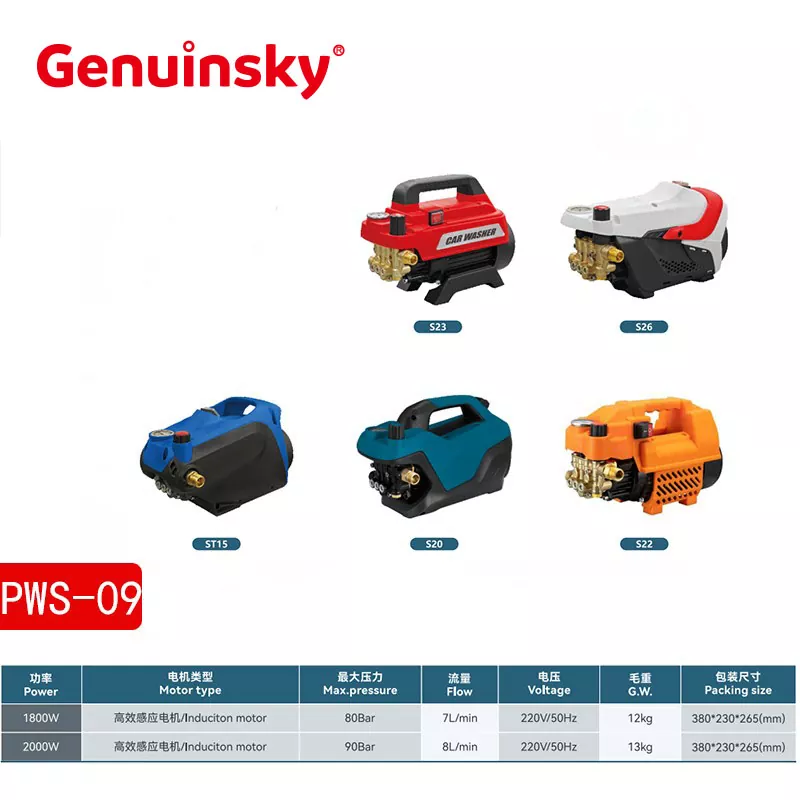
Different induction-motor pressure washers are built for different needs. Here's a quick snapshot of real-world models:
| Category | Power | Max Pressure | Max Flow | Weight |
|---|---|---|---|---|
| Entry Home Use | 1.2 kW | 90 Bar | 5.0 L/min | ~8 kg |
| Advanced Home Use | 2.0 kW | 160 Bar | 7.2 L/min | — |
The entry model is lightweight and perfectly capable for routine car washing and light patio cleaning. The advanced model delivers noticeably higher pressure and flow – it'll handle stubborn grime and larger areas with less time and effort. For heavy-duty needs like removing algae from walls or cleaning farm equipment, consider a 3 kW / 190 Bar class machine – these often include self-priming and thermal protection for sustained operation.
Also look for Total Stop System (TSS) – it automatically reduces motor speed or shuts it off when you release the trigger. This prevents pressure from building up inside the pump, which extends seal and pump life while saving electricity.
Three maintenance habits that actually matter:
Clean the inlet filter – once every week or two, depending on water quality. Debris is the #1 killer of pump seals.
Check and change pump oil – roughly every three months of regular use. Refer to your manual for grade and quantity.
Never run it dry – even a few seconds of dry operation can permanently damage ceramic plungers and seals.
A great pressure washer isn't about "maximum brute force." It's about an induction motor that keeps running year after year, and a responsive pressure regulator that gives you control over every job – from delicate detailing to heavy-duty stripping. Next time you're choosing a model or adjusting the dial, remember: it's the heart and brain working together that make the real difference.